
The Coaching Habit: 7 Questions That Will Transform the Way You Lead

There’s a moment every manager knows. Someone walks into your office or drops into your Slack with a problem. And within about 30 seconds, you’re already mentally assembling solutions, composing advice, preparing to be the smartest person in the room.
It feels good. It feels helpful.
But here’s the uncomfortable truth: that impulse — what author Michael Bungay Stanier calls your “Advice Monster” — might be one of the most quietly destructive habits in your entire leadership toolkit.
In The Coaching Habit: Say Less, Ask More & Change the Way You Lead Forever, Stanier argues that most managers are accidentally creating three vicious cycles: overdependence (your team can’t move without you), overwhelm (you’re buried in other people’s work), and disconnection (you’re busy but not doing anything that actually matters).
The antidote isn’t a leadership framework or a new performance system. It’s seven questions.
I picked up this book expecting another management framework to file away and forget. What I got instead was a mirror. Within the first chapter I could name exactly which vicious cycle I was stuck in — my team was good, but they waited for me on everything. Every decision, every ambiguous situation, every bit of friction eventually landed on my desk. I thought I was being helpful. The book made me realize I was being the bottleneck.
This is a deep dive into all seven questions — with real workplace scenarios, examples across different roles, and the neuroscience behind why they actually work.
Why Most Coaching Fails Before It Starts
Before the questions, let’s address what coaching actually is — and isn’t.
Most people think coaching means giving guidance, sharing experience, or setting someone straight. That’s mentoring, or advising, or managing. Coaching is something different: it’s helping someone think better for themselves, rather than thinking for them.
The problem is our brains are wired against it. When someone presents a problem, our prefrontal cortex lights up with pattern-matching and solution-generation. It genuinely feels like we’re helping. But research shows that when someone receives advice they didn’t ask for, they’re far less likely to act on it — and far less likely to learn from the situation.
Building a coaching habit solves this at a behavioral level. Stanier draws on neuroscience and behavioral economics to outline a simple framework for habit change:
- A reason — the payoff for changing (connected to how it helps others, not just you)
- A trigger — the specific moment that kicks off the old behavior
- A micro-habit — a new behavior that takes 60 seconds or less
- Deep practice — repetition with mindfulness
- A plan — what you’ll do when you stumble
The New Habit Formula looks like this:
When this happens [trigger]… instead of [old habit]… I will [new micro-behavior].
For example: “When someone comes to me with a problem, instead of immediately offering a solution, I will ask ‘What’s on your mind?’”
Simple. But it changes everything.
The 7 Essential Questions
1. The Kickstart Question: “What’s on your mind?”
Most meetings start the wrong way. Small talk, status updates, agenda items that nobody cares about. By the time you get to the real issue, you’re out of time.
“What’s on your mind?” is what Stanier calls a Goldilocks question — not too open, not too narrow. It’s an invitation to skip the preamble and go straight to what matters most.
Why it works: It grants the other person autonomy. You’re not directing the conversation. You’re not projecting what you think the problem is. You’re creating space for them to bring what’s actually consuming them.
Use it to drill deeper with the 3P Model:
Once someone answers, you can focus the conversation using three lenses — Project, People, and Patterns:
- Project: the actual work — deliverables, timelines, tasks
- People: the relationships and interpersonal dynamics at play
- Patterns: recurring behaviors or ways of working that might be getting in the way
You can surface these explicitly:
“There are three different angles we could explore here. The project side — any challenges with the actual work. The people side — any friction with colleagues, customers, or stakeholders. And patterns — any ways you might be getting in your own way. Where would you like to start?”
Real scenarios:
Scenario A — The overwhelmed engineer Your senior developer, Priya, messages you: “I need to talk. Things aren’t going well.” Your old instinct: ask about the project timeline, assume it’s a technical blocker, start solving.
With the Kickstart Question: “What’s on your mind, Priya?”
She might say the project is fine — but she’s having a hard time with a new teammate who keeps undermining her in meetings. That’s a people challenge, not a project one. You’d have spent the whole meeting solving the wrong problem.
Scenario B — The stalled sales rep Marcus, a mid-level sales rep, says he wants to talk about his pipeline. “What’s on your mind?” opens it up. He starts with numbers (project), but when you probe the people angle, you learn he’s dreading a recurring call with a difficult client and has been unconsciously avoiding it — a pattern of avoidance that’s killing his pipeline.
Scenario C — The high performer who seems disengaged Yuki used to be your most energized team member. Lately she’s going through the motions. “What’s on your mind?” might surface that she’s been quietly wondering if her work still matters — a patterns conversation about meaning and purpose that no status meeting would ever reach.
2. The AWE Question: “And What Else?”
Three small words. Enormous power.
The first answer someone gives you is almost never the complete answer, and rarely the best one. But the moment someone offers an answer, we tend to latch onto it and start solving. “And What Else?” (AWE) breaks that pattern.
It does three things simultaneously:
- Generates more options — better decisions come from more possibilities
- Reins you in — it keeps your Advice Monster caged while you gather more information
- Buys you time — a moment to actually think before responding
The ideal range: Aim for 3–5 answers before moving on. Research on how the brain chunks information suggests four is roughly optimal — beyond that, you’re diminishing returns.
Real scenarios:
Scenario A — The product roadmap debate Your product manager, Diego, says the main challenge is deciding which feature to build next. You might know exactly what you think the answer is. But ask: “And what else might be affecting this decision?”
He adds: budget constraints, an upcoming conference where a competitor might announce something similar, a sales team that keeps requesting features that don’t align with the product vision. Now you’re looking at a strategic and organizational problem, not just a prioritization puzzle.
Scenario B — The underperforming team A team lead tells you morale is low because of the remote work policy. “And what else?” might surface: unclear OKRs, two teammates who have ongoing tension, a project that’s been in limbo for six months, and a sense that leadership doesn’t value their work. The remote policy is just the surface. AWE helped you reach the roots.
Scenario C — The job offer negotiation This question works outside pure work contexts, too. If someone on your team tells you they’ve received an external offer and they’re considering it, “And what else is driving this?” opens up a richer conversation than jumping into counter-offer mode. They might reveal it’s not about money — it’s about feeling underutilized, or wanting a clearer career path, things you can actually address.
The key is to stay genuinely curious. You’re not playing 20 questions to trap someone. You’re treating their first answer as the beginning of the story, not the end.
3. The Focus Question: “What’s the real challenge here for you?”
This is arguably the most important question in the book. And the most counterintuitive.
When someone presents a problem, your brain immediately wants to solve that problem. But the problem they present is almost never the actual problem. Stanier calls jumping to solve the presenting problem one of three ways things go off the rails: you work on the wrong problem, you do the work your team should be doing, and the work doesn’t get done.
The Focus Question forces a deliberate pause before action.
Notice how it’s constructed:
- “What’s the challenge?” — too vague; generates abstract answers
- “What’s the real challenge here?” — better; implies there are multiple challenges, forces prioritization
- “What’s the real challenge here for you?” — best; pins it to the person in front of you, prevents abstract pontification
The three Foggy-fiers to watch for:
1. Proliferation of Challenges — they list twelve problems. Instead of picking one for them, ask: “If you had to focus on just one of these, which would be the real challenge for you?”
2. Coaching the Ghost — they spend the whole time talking about someone else (the difficult boss, the unreliable vendor, the teammate who doesn’t pull their weight). Acknowledge it, then redirect: “I hear you on what’s going on with [that person]. What’s the real challenge here for you in this situation?”
3. Abstractions & Generalizations — the conversation is high-altitude and theoretical. “We” statements everywhere, no “I.” Ground it: “I sense the broader context. What’s the real challenge here for you, personally?”
Real scenarios:
Scenario A — The project crisis Your engineering lead rushes in: “The client is unhappy, the deadline is unrealistic, the QA team is understaffed, and half the requirements changed last week.” That’s a proliferation of challenges.
“If you could only fix one of these, which is the real challenge here for you?”
He pauses. “Honestly? I don’t feel like I have permission to push back on the client.” That’s a very different conversation than a project management problem.
Scenario B — The team conflict Your team lead spends 20 minutes venting about a colleague who keeps undermining her ideas in meetings. Classic ghost coaching.
“I understand that sounds incredibly frustrating. What’s the real challenge here for you?”
She goes quiet, then: “I’m not sure I’m asserting myself the way I need to. I always defer when someone pushes back.” Now you’re coaching her growth, not the other person’s behavior.
Scenario C — The strategy meeting A senior leader keeps talking in abstractions: “We need to think about how we as an organization are evolving our go-to-market strategy in the context of shifting macroeconomic headwinds.”
“That’s the big picture. What’s the real challenge here for you, specifically?”
“I’m afraid I don’t know enough about the customer to make this call and I’m worried about making the wrong bet.” Suddenly you have something concrete to work with.
4. The Foundation Question: “What do you want?”
Simple. Devastating. Rarely asked.
George Bernard Shaw once said: “The single biggest problem with communication is the illusion that it has taken place.” The illusion that both parties know what the other party wants is one of the most pervasive sources of frustration in organizations.
There’s an important distinction Stanier makes: wants vs. needs.
A want is the surface request — get this report done by Thursday, cover for me in the meeting, get my manager to listen to me.
A need goes deeper. Drawing on economist Manfred Max-Neef’s nine universal human needs — affection, creation, recreation, freedom, identity, understanding, protection, subsistence, participation — Stanier suggests that behind every want is a deeper driver you can learn to read.
Reading the need behind the want:
| What They Say (Want) | What They Might Need |
|---|---|
| “I want you to talk to the VP for me” | Protection (I feel too junior), or Participation (I need to feel included) |
| “I want to leave early today” | Understanding (something difficult at home), or Creation (I need to get to my class) |
| “I need a new version of this report” | Freedom (I hate this task), Identity (I want to feel like the boss), Subsistence (my success depends on this) |
| “I need you to make a decision on this” | Protection (I don’t want to be blamed), Understanding (I’m confused) |
The TERA model — four neurological drivers that make an environment feel safe or threatening — helps explain why asking “What do you want?” is so powerful:
- T (Tribe): “Are you with me or against me?” Asking what they want signals you’re on their side.
- E (Expectation): “Do I know what’s coming?” Clarity reduces anxiety.
- R (Rank): “Am I valued here?” Letting them speak first honors their status.
- A (Autonomy): “Do I have a say?” Asking rather than telling preserves their sense of control.
Every time you ask “What do you want?” you increase all four TERA drivers simultaneously.
Real scenarios:
Scenario A — The ambiguous meeting request Someone from another team says: “We need to align on the Q3 priorities.”
You assume they want a project sync. You prepare slides. They actually want you to make a unilateral call so they can stop being stuck. Asking “What do you want from this conversation?” saves both of you an hour of misdirected preparation.
Scenario B — The frustrated direct report Chen keeps bringing you problems and seeming unsatisfied with your responses. You’ve tried everything — solutions, empathy, resources.
Try: “What do you actually want from me when you bring me these situations? A sounding board? Advice? Just someone to hear you out?”
He says: “Honestly, I mostly just want to feel like you trust me to handle it.” You’ve been providing solutions when he needed validation. The relationship shifts immediately.
Scenario C — The parenting/personal context The book notes these questions work beyond work — with spouses, teenage children, even customers. A teenager saying “I want you to stop asking about school” might really need autonomy (freedom) and trust (identity). Asking “What would actually help right now?” opens more than an argument could.
5. The Lazy Question: “How can I help?”
This one has a deceptive name. It’s not lazy in the dismissive sense — it’s lazy in the best possible way: it stops you from doing unnecessary work.
Here’s the trap: you’re a helpful person. When someone comes to you with a problem, you want to add value. So you start helping. You take on tasks. You make calls. You attend meetings.
But a lot of the time, you’re helping in a way they didn’t ask for — and sometimes don’t want. You’ve become a Rescuer.
Stanier uses the Drama Triangle — a model developed by Stephen Karpman — to explain a pattern that repeats constantly in organizations:
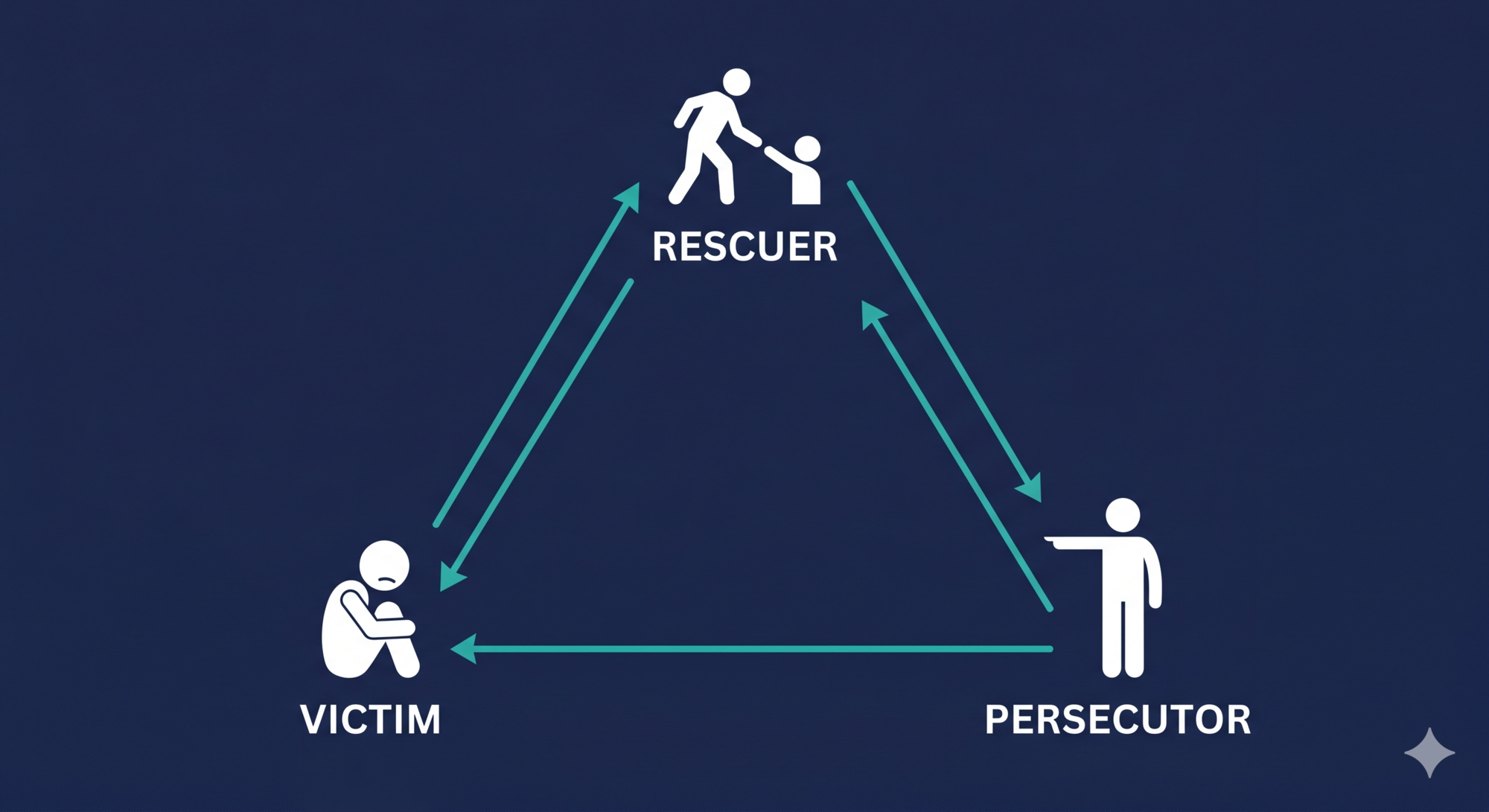
The three roles:
- Victim: “This is happening to me and there’s nothing I can do.”
- Persecutor: “This is your fault. You’re the problem.”
- Rescuer: “I’ll save you. Let me take care of this.”
The problem is that all three roles are dysfunctional. The Rescuer feels virtuous but actually keeps the Victim dependent and powerless. And managers with high helpfulness drives are almost always unconscious Rescuers.
“How can I help?” forces the other person to make a direct, clear request. And it forces you to stop assuming you know what help is needed.
Crucially, “How can I help?” doesn’t mean “Yes.” Your response options:
- Yes — straightforward.
- No, I can’t do that — harder, but sometimes right. Courage to say No is part of breaking the Rescuer cycle.
- I can’t do that, but I could do [X] — a productive counter-offer.
- Let me think about it — buying time to make a considered decision.
Real scenarios:
Scenario A — The team member who “just needs a minute” A colleague stops you in the hallway: “Do you have a minute? I just need your input on something.”
Old behavior: you say “sure” and spend 45 minutes debugging their strategic decision.
With the Lazy Question: “What kind of input do you actually need from me?”
She says: “Honestly, I just need you to sanity-check one assumption.” Two minutes. Done.
Scenario B — The Rescuer spiral Your junior PM, Alex, keeps escalating decisions to you. You keep deciding. He’s become dependent, and you’re drowning.
Try: “How can I actually help you here, in a way that doesn’t involve me making the call?”
He pauses. “I guess I need you to help me feel more confident that my judgment is sound.” Now you’re coaching toward self-sufficiency instead of perpetuating dependence.
Scenario C — The upstream manager Your own boss dumps a last-minute project on you with a vague brief.
“Before I dive in, how can I help with this in a way that makes the biggest difference for you?”
She clarifies the real outcome she needs — which is narrower than what the brief implies. You save yourself three days of unnecessary work.
6. The Strategic Question: “If you’re saying Yes to this, what are you saying No to?”
This question is about the hidden cost of commitment.
We live in a culture that defaults to Yes. Corporate cultures make “probably” the minimum acceptable response to most requests. We pile commitments into our lives like a magical bag that never runs out of space — until suddenly everything in the bag is half-done and nothing is excellent.
Stanier identifies two kinds of No that every Yes implies:
The No of Omission: the things that automatically get displaced. If you say Yes to attending a Thursday afternoon meeting, you’re saying No to something else happening Thursday afternoon — a focus block, an important project, picking up your kid from school.
The No of Commission: the active behaviors and investments you’ll need to stop doing to actually honor your new Yes. If you say Yes to a major new initiative, you need to say No to something already on your plate.
The question “If you’re saying Yes to this, what are you saying No to?” is a spotlight. It creates clarity and commitment rather than murky obligation.
Saying Yes more slowly — a phrase Stanier borrows from facilitator Bill Jensen — is the real skill. It means staying curious before committing:
- Why are you asking me, specifically?
- Whom else have you asked?
- What does “urgent” actually mean here?
- What standard does “done” need to meet?
- If I could only do part of this, which part matters most?
- What would you need me to stop doing to make room for this?
Real scenarios:
Scenario A — The new feature request Your product team wants to add a major feature before launch. “If we say Yes to building this now, what are we saying No to?”
The team lists: the performance improvements that are already 70% done, the onboarding redesign that reduces churn, and the tech debt sprint scheduled for next quarter. Suddenly the feature request looks very different.
Scenario B — The “stretch opportunity” Your manager offers you a high-visibility cross-functional project on top of your current work. You’re flattered. You want to say yes immediately.
“If I say yes to this, what am I saying no to?” You walk through your current commitments. One of them is a critical delivery your team is counting on. You go back to your manager: “I want to take this on. What could we move off my plate to make room?”
That’s not being difficult — it’s being responsible.
Scenario C — The team member’s overcommitment Your developer is excited about every project and keeps saying Yes to everything. She’s starting to burn out.
“You’re clearly excited about all of these. If you were to say a strong Yes to one, what would you have to say No to?”
She starts to see — for the first time — that her Yes doesn’t exist in a vacuum. Every Yes is a trade-off, and she gets to make that trade consciously.
7. The Learning Question: “What was most useful for you?”
Most conversations end with action items. The learning question closes with insight.
Here’s the neuroscience behind why this matters: people don’t learn when they’re told something. They don’t even really learn when they do something. Learning — the formation of new neural pathways — happens when they recall and reflect on what happened.
Stanier references the AGES model from the Neuro Leadership Institute:
- Attention
- Generation (creating your own connections to new ideas — this is the key one)
- Emotion
- Spacing
The G — Generation — is what “What was most useful for you?” activates. Instead of you telling them the lesson, you prompt them to generate it themselves. What they self-generate, they remember and own.
Notice why “What was most useful for you?” is better than:
- “Was this useful?” — yes/no, no insight generated
- “What did you learn?” — slightly better, but abstract
- “What do you want to remember?” — good, but vague
“What was most useful for you?” assumes the conversation had value (frames it positively), forces a prioritization (one thing, not everything), and makes it personal (“for you”) so they’re not reporting back what they think should have been useful.
It also gives you feedback. If they say something totally unexpected, you learn something about what actually landed versus what you thought was your best point.
Real scenarios:
Scenario A — After a coaching conversation You’ve just spent 30 minutes with a team member working through a difficult decision. Before she leaves: “Before you go — what was most useful about this conversation for you?”
She says: “Honestly, just being asked what I actually wanted. I don’t think anyone’s ever asked me that before.” You learn that autonomy and being heard matter more to her than any advice you gave.
Scenario B — After a difficult team meeting A tense retrospective finally surfaces some uncomfortable truths. Closing with “What was most useful from this session?” shifts the room from cathartic venting to extracting value. Three different people name three different things — and that diversity itself tells you something about what your team needed.
Scenario C — After an onboarding session New hire Jamie has just completed his first month. “What’s been most useful about the onboarding so far?”
His answer: “The pairing sessions with the senior engineers, not the documentation.” That’s a signal about how your team actually learns — and it’s more actionable than any satisfaction survey.
Putting It All Together: The Coaching Bookends
Stanier’s most powerful insight is that you don’t need to use all seven questions every time. The real structure is what he calls the Coaching Bookends — a pair of questions that can frame almost any conversation:
Open with: “What’s on your mind?” → gets you to what actually matters
Close with: “What was most useful for you?” → locks in the learning
Everything in between — the AWE question, the Focus question, the Foundation question — is there to deepen the middle of the conversation as needed.
A fully-scripted coaching exchange might look like this:
“What’s on your mind?” [They answer] “And what else?” [They go deeper] “So what’s the real challenge here for you?” [They identify the core issue] “What do you want from me here?” [They clarify the request] “How can I help?” [They make a specific ask] “If we do that, what are we saying No to?” [They consider trade-offs] “What was most useful for you about this conversation?” [Learning embedded]
You won’t always use all seven. But having them available — and making asking them a habit rather than a deliberate choice — is the whole game.
The Bigger Shift: From Advice to Curiosity
All seven questions point to the same underlying shift: from leading with answers to leading with curiosity.
That’s uncomfortable. Advice feels fast, certain, and valuable. Curiosity feels slow, vulnerable, and like you’re not contributing. But the evidence — from neuroscience, from organizational psychology, from practical management experience — points the other way.
When you ask instead of tell:
- People own their solutions and are more likely to act on them
- Your team becomes more capable and less dependent over time
- You focus your energy on challenges that truly require your expertise
- Conversations go deeper and relationships get stronger
- You make fewer decisions about things you don’t fully understand
The Advice Monster will always be there. The question is whether you let it run the conversation.
“The real secret sauce is building a habit of curiosity. The change of behavior that’s going to serve you most powerfully is simply this: a little less advice, a little more curiosity.” — Michael Bungay Stanier
Quick Reference: The 7 Questions
| Question | Purpose | Use When |
|---|---|---|
| “What’s on your mind?” | Open the conversation | Starting any 1:1 or check-in |
| “And what else?” | Expand possibilities | After any first answer |
| “What’s the real challenge here for you?” | Find the actual problem | When you sense the surface isn’t the core |
| “What do you want?” | Clarify the request | When needs are unclear or assumed |
| “How can I help?” | Define your role | Before you jump in to fix |
| “If you’re saying Yes to this, what are you saying No to?” | Surface trade-offs | Before commitments are made |
| “What was most useful for you?” | Embed learning | At the close of any conversation |
Building Your Own Coaching Habit
The book’s final challenge is deceptively simple: don’t add these questions to your mental checklist. Build them into your behavioral wiring.
Use the New Habit Formula:
“When [someone comes to me with a problem], instead of [launching into advice], I will [ask ‘What’s on your mind?’]”
The shift from advice-giver to coaching leader is not a personality change. It’s a behavioral one. And that means starting small — embarrassingly small.
Here’s your one action for this week: In your next 1:1, resist the urge to open with a status check or agenda item. Start with “What’s on your mind?” and say nothing else. Just wait. See what comes up.
That’s it. One question, one conversation. You’ll be surprised how different the room feels. The Kickstart Question is the easiest entry point because it requires zero context — it works cold, mid-meeting, or in a hallway. Practice it until it’s reflex. Then, only then, pick up the AWE Question. Habits compound. But only if you actually start.
References
- Stanier, Michael Bungay. The Coaching Habit: Say Less, Ask More & Change the Way You Lead Forever. Box of Crayons Press, 2016.
- Duhigg, Charles. The Power of Habit. Random House, 2012.
- Coyle, Dan. The Talent Code. Bantam Books, 2009.
- Pink, Daniel. Drive: The Surprising Truth About What Motivates Us. Riverhead Books, 2009.
- Karpman, Stephen. Drama Triangle model, adapted in The Coaching Habit.
- Max-Neef, Manfred. Human Scale Development model.
- Neuro Leadership Institute. AGES Model for learning and memory.
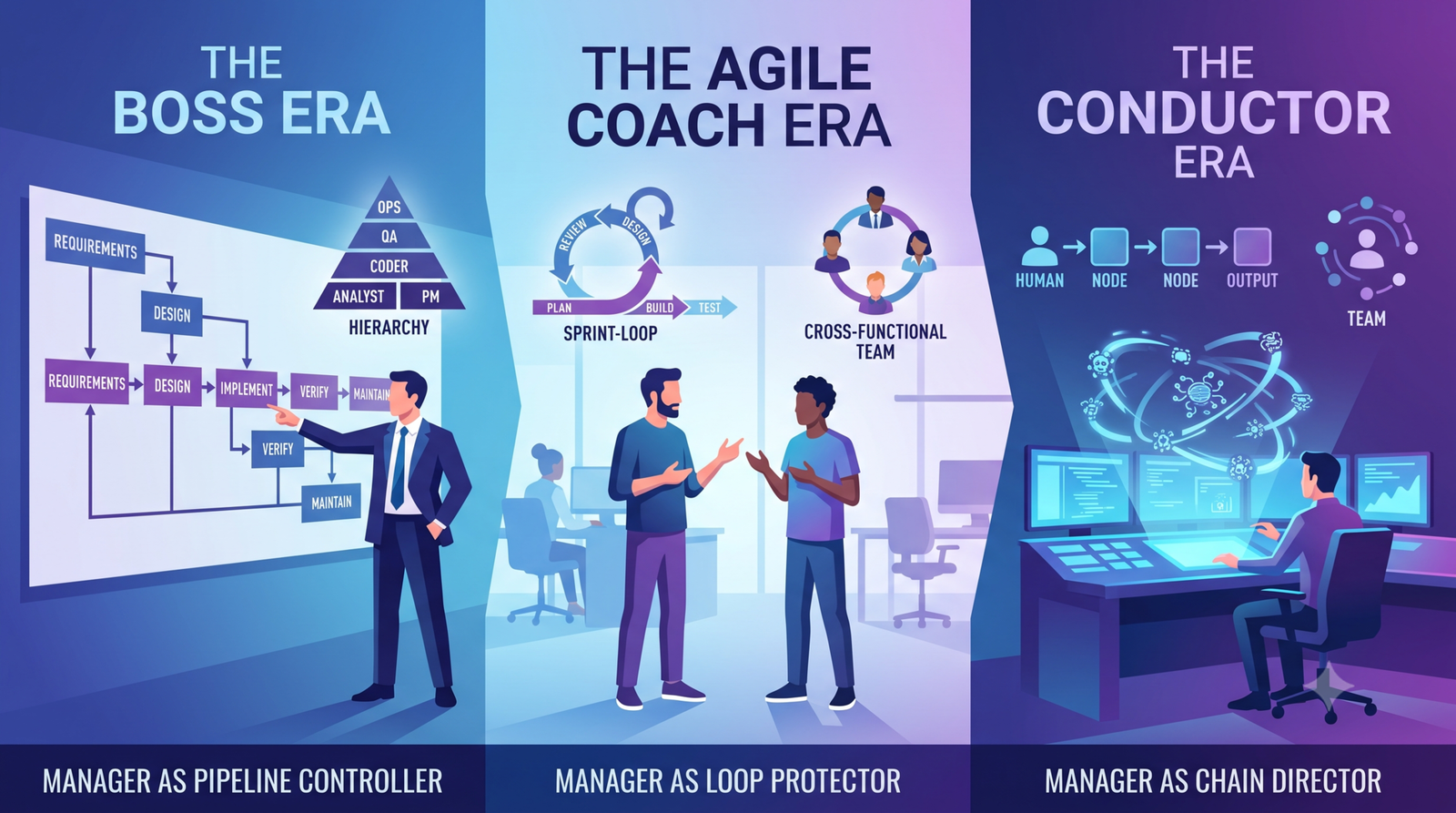
- From Boss to Coach to Conductor: The 50-Year Evolution of Software Management — how the manager’s role evolved in parallel with the SDLC
- AI Makes Engineers 5x Faster. It Doesn’t Make You a 5x Manager. — why coaching becomes more important, not less, in the AI era
Have thoughts on this?
I read every email. If something resonated, felt wrong, or made you think — I'd love to hear from you.

Comments